Serverless File Processing Pipeline
Upload files, detect format, run a configurable pipeline (convert, extract, enrich), and deliver results with observable, secure AWS primitives.
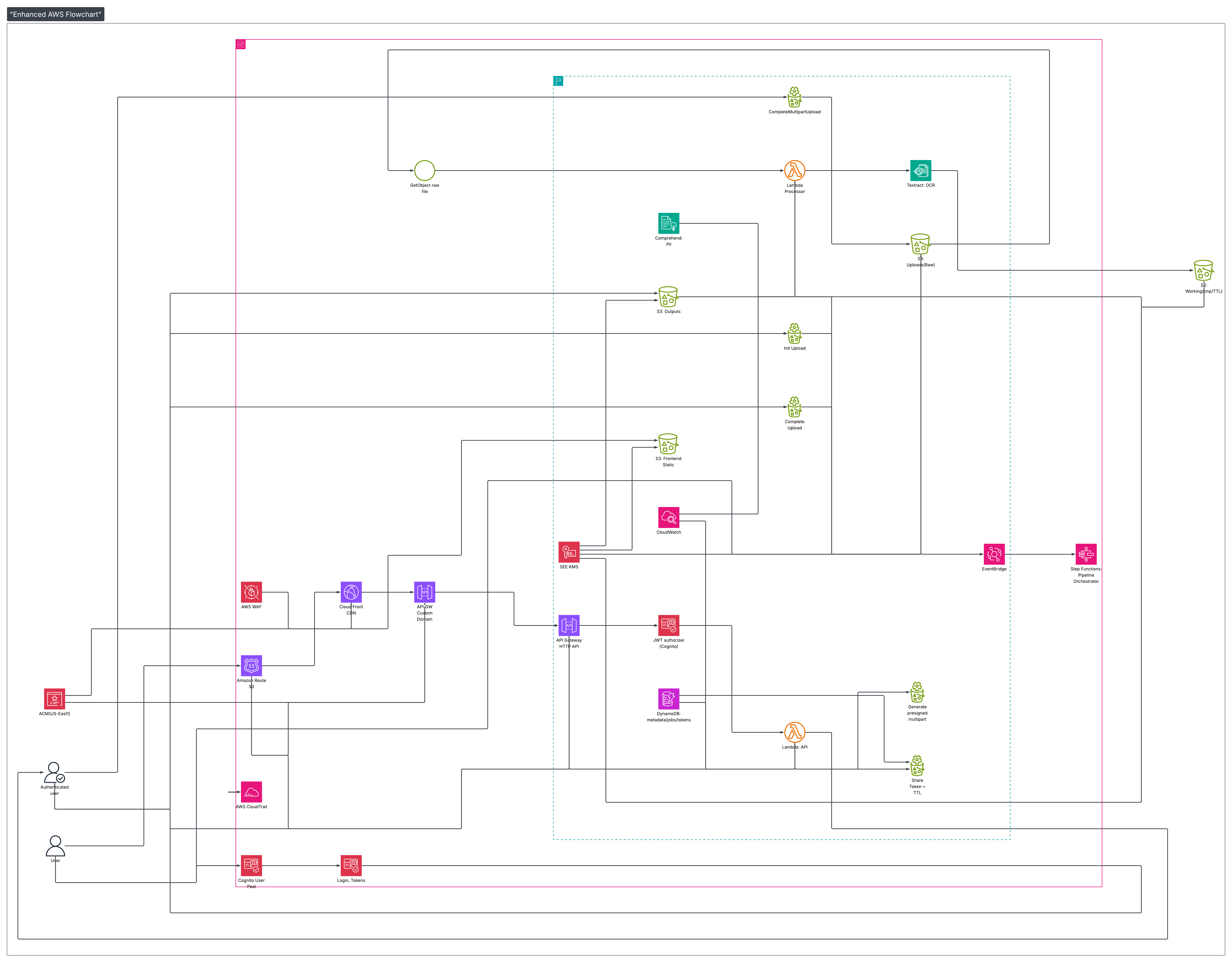
Browser → S3 (presigned) → SQS → Lambda → DynamoDB + outputs.
Problem Statement
Constraints, scale, and what success looks like.
A serverless-first pipeline platform that lets users upload files and run transformations with strong isolation and auditability.
Solution
How the system works end-to-end.
A serverless-first pipeline platform that lets users upload files and run transformations with strong isolation and auditability.
AWS Services Used
Core services and why they are in the design.
Architecture Decisions
Tradeoffs and reasoning behind key choices.
SQS between S3 and Lambda
Buffers spikes and enables retries/DLQ. Avoids direct fan-out failures from S3 events at scale.
Security Model
IAM, encryption, and exposure controls.
Least-privilege IAM roles per function
S3 SSE-KMS encryption and TLS-only
Pre-signed URL with short TTL and content-type constraints
Reliability Patterns
Retries, DLQs, idempotency, and resilience.
Retries with backoff and DLQ for poison messages
Idempotency to prevent double-processing
Observability
Logs, metrics, alarms, and tracing.
Structured logs with correlation IDs
CloudWatch metrics + alarms on error rate and latency
Tracing for the pipeline steps where useful
Cost Considerations
Cost drivers and how you keep them under control.
- Primary drivers: Lambda duration, S3 storage/requests, data transfer
- Mitigations: batching, right-sized memory, lifecycle policies
Key Takeaways
What you learned and what you would improve next.
- Add auth (Cognito) + per-user isolation
- Add admin dashboard and cost visibility
Technologies Used
Quick scan of tools used in this build.